
Which Companies Are at Risk?
How the AI-First One-Person Institution Could Reshape Entire Industries

Executive Summary
Every major technological revolution changes the structure of business. The Industrial Revolution transformed manual labor. The Internet transformed communication and commerce. Artificial intelligence is now transforming the very concept of the firm itself.
For generations, companies scaled by hiring people. Revenue growth required additional employees, larger departments, more management layers, and increasingly complex organizational structures. Businesses were designed around the assumption that productive capacity depended on human labor.
Artificial intelligence challenges that assumption.
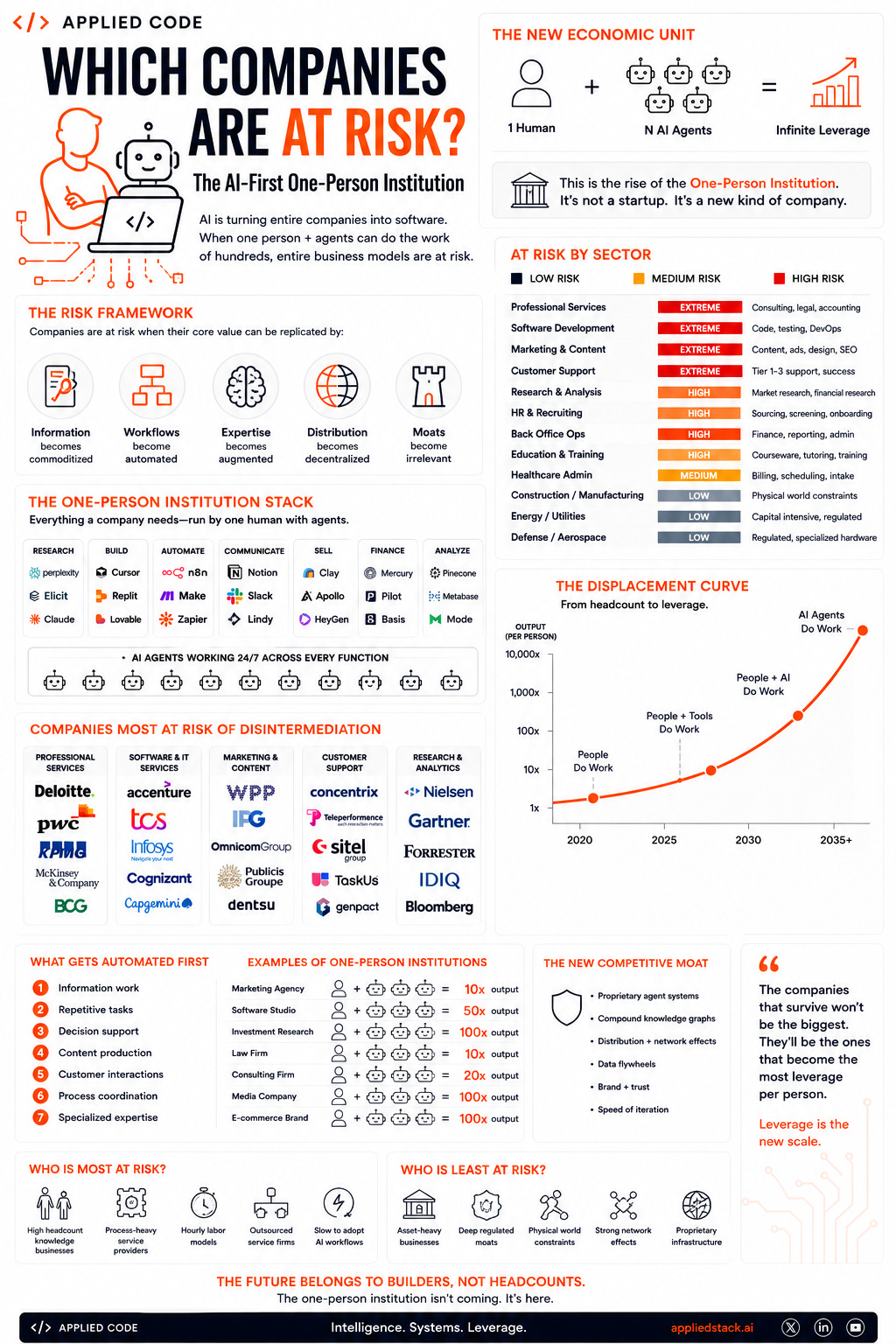
For the first time, a single individual can coordinate a workforce composed largely of software. AI agents can conduct research, write content, analyze data, build software, manage customer relationships, execute marketing campaigns, generate reports, monitor systems, and perform countless operational tasks that previously required teams of specialists.
The result is the emergence of what can be described as the AI-First One-Person Institution.
This new organizational model combines human judgment, strategic thinking, and vision with a scalable workforce of AI agents operating continuously across multiple functions. Instead of building companies around headcount, entrepreneurs can increasingly build organizations around intelligence, automation, and systems.
This development creates enormous opportunities for those who embrace it. It also creates significant risks for businesses whose value depends primarily on labor-intensive knowledge work that can now be replicated by intelligent systems.
This paper examines which industries are most vulnerable, why the shift is occurring, how quickly disruption may unfold, and what organizations must do to remain competitive in an AI-driven economy.