

Space-Based Connectivity: The Rise of Satellite Internet and the New Global Infrastructure Race
How Starlink, SpaceX, Amazon, and Emerging Constellations Are Rebuilding the Internet From Orbit

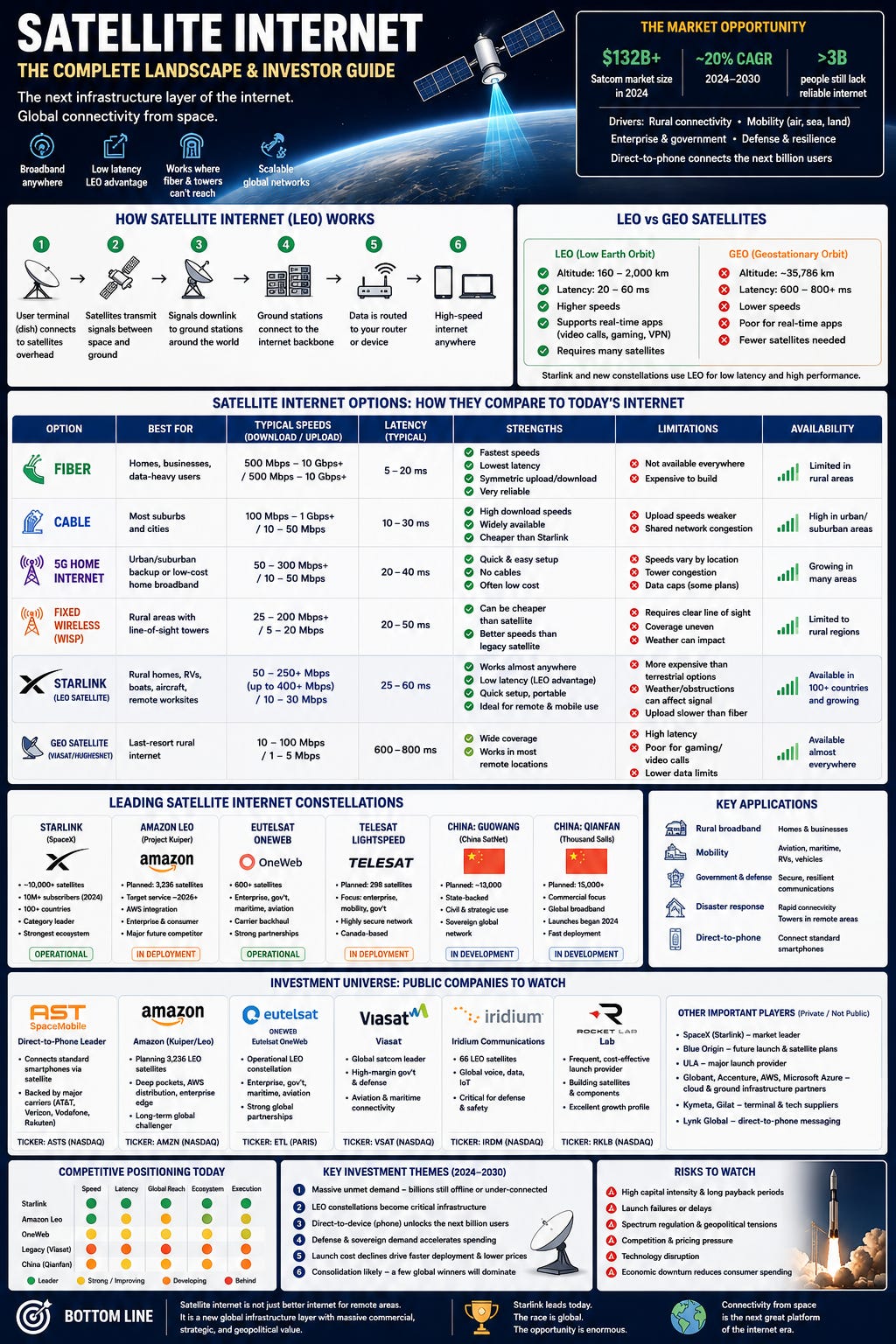
Executive Summary
The internet has become one of the most important infrastructures in modern society. It powers economies, governments, education, commerce, defense, healthcare, and communication. Yet despite decades of investment, billions of people still lack access to reliable high-speed internet.
Traditional broadband infrastructure has inherent limitations. Fiber networks are expensive to deploy in remote regions. Cellular towers require dense coverage and substantial capital investment. Rural communities, maritime operators, airlines, disaster zones, and developing nations often remain underserved because conventional infrastructure cannot economically reach them.
Satellite internet is changing this equation.
For decades, satellite connectivity was associated with high latency, slow speeds, and limited usability. Older geostationary satellite systems delivered internet from satellites positioned over 35,000 kilometers above Earth, creating delays that made real-time applications difficult.
A new generation of satellite networks is fundamentally different.
Low Earth Orbit (LEO) constellations place thousands of satellites much closer to Earth, dramatically reducing latency while increasing speed and reliability. This technological breakthrough is enabling internet access that can rival terrestrial broadband in locations where traditional infrastructure is impractical or impossible.
At the center of this transformation stands Starlink, SpaceX’s rapidly expanding satellite internet network. However, Starlink is only one participant in a broader race that includes Amazon’s Project Kuiper, Eutelsat OneWeb, Telesat, AST SpaceMobile, Iridium, and several government-backed initiatives across the world.
The emergence of satellite internet represents more than a telecommunications story. It is the construction of a new global infrastructure layer that may become as important as roads, railways, ports, power grids, and cellular networks.
This paper explores how satellite internet works, why the industry is growing rapidly, the competitive landscape, investment implications, and why SpaceX may hold a unique strategic advantage.
The Internet’s Last Mile Problem
One of the largest challenges in telecommunications has always been geography.
Fiber optic networks provide extraordinary performance, but deploying them requires extensive physical infrastructure. Every mile of cable requires construction, maintenance, permitting, and ongoing operational costs.
In dense urban environments, these investments make economic sense because many customers can be served from a relatively small footprint.
Rural environments present a different reality.
Extending broadband to sparsely populated areas often becomes prohibitively expensive. The cost per customer rises dramatically while revenue opportunities remain limited.
As a result, billions of people worldwide continue to experience inadequate connectivity.
This challenge is commonly referred to as the “last mile problem,” although in many regions it is actually a last hundred-mile problem.
Satellite internet bypasses these physical constraints.
Instead of bringing cables to users, connectivity is delivered directly from space.
This dramatically changes the economics of global broadband deployment.
How Modern Satellite Internet Works
The architecture of modern satellite internet is surprisingly elegant.
A user installs a small satellite terminal, often referred to as a dish. This device communicates directly with satellites moving overhead in low Earth orbit.
Those satellites relay information either to nearby ground stations connected to the global internet backbone or increasingly through inter-satellite laser links that allow data to travel directly through space.
The network continuously routes traffic through the most efficient path available.
Because satellites are moving rapidly across the sky, users are constantly handed off between satellites without interruption.
The result is a seamless internet experience that functions similarly to traditional broadband while operating through a completely different infrastructure model.
Unlike older satellite systems that relied on a small number of large satellites positioned far from Earth, modern LEO constellations use thousands of smaller satellites working together as a coordinated network.
This design enables lower latency, greater capacity, and significantly improved performance.
Why Low Earth Orbit Changes Everything
The key innovation behind modern satellite internet is not merely the satellite itself.
It is the orbit.
Traditional geostationary satellites operate approximately 35,786 kilometers above Earth. Signals must travel enormous distances, creating latency that often exceeds 600 milliseconds.
For activities such as web browsing, email, or file downloads, this may be acceptable.
For applications such as video conferencing, gaming, cloud computing, financial transactions, or real-time collaboration, it creates significant limitations.
Low Earth Orbit satellites typically operate between 300 and 1,200 kilometers above the planet.
This dramatically shortens the distance signals must travel.
As a result, latency often falls into the 20 to 60 millisecond range, comparable to many terrestrial broadband services.
This improvement transforms satellite internet from a niche connectivity solution into a legitimate broadband competitor.
The shift from GEO to LEO is similar to replacing a cross-country road trip with a local commute.
The shorter distance changes everything.
Starlink: The Category Leader
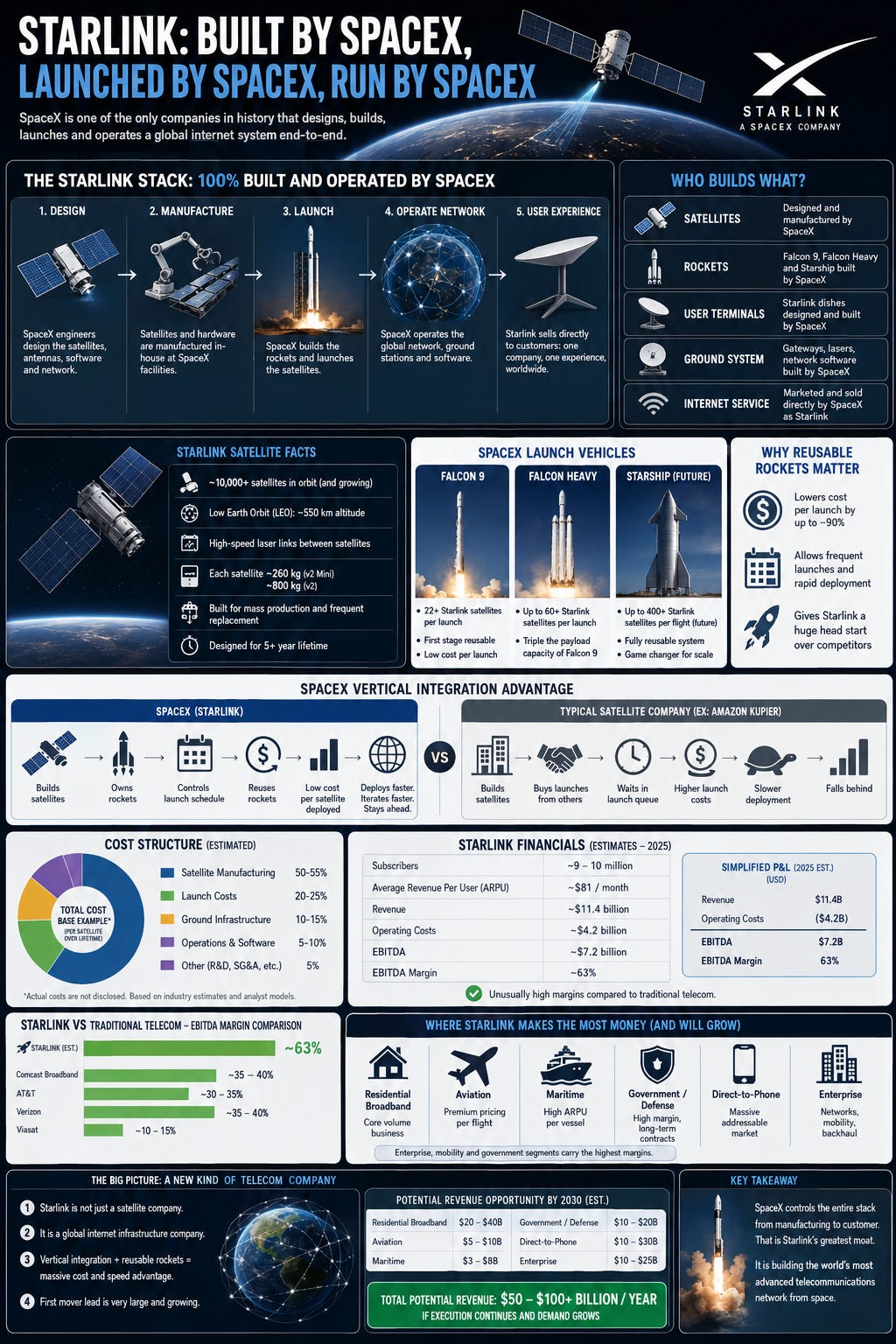
Among all current satellite internet providers, Starlink has established the strongest position.
Developed and operated by SpaceX, Starlink represents one of the largest communications infrastructure projects ever undertaken by a private company.
Its mission is straightforward: create a global broadband network capable of serving customers virtually anywhere on Earth.
The scale of this effort is extraordinary.
Thousands of Starlink satellites already operate in orbit, with additional launches occurring regularly. The network serves residential users, businesses, governments, airlines, maritime operators, military organizations, and emergency response teams across more than one hundred countries.
Unlike traditional telecommunications providers that rely heavily on terrestrial infrastructure, Starlink’s network is inherently global.
A customer in a remote mountain region, an aircraft crossing an ocean, a ship at sea, or a disaster recovery team operating in a damaged area can all access the same underlying system.
This geographic flexibility represents one of Starlink’s greatest competitive advantages.
Why SpaceX Has an Advantage
One of the most important insights about Starlink is that it is not simply a satellite internet company.
It is the product of an integrated aerospace ecosystem.
Most satellite operators must purchase launches from third-party providers. This creates dependence, scheduling constraints, and significant costs.
SpaceX operates differently.
The company designs the satellites, manufactures them, launches them, operates the network, builds customer terminals, and sells internet services directly to users.
This level of vertical integration is rare.
Because SpaceX owns the launch infrastructure, it can deploy satellites more frequently and at lower cost than many competitors.
Reusable rockets further amplify this advantage.
By dramatically reducing launch costs, SpaceX can scale its constellation more efficiently while maintaining economic flexibility.
This creates a strategic moat that extends far beyond broadband service itself.
Starlink benefits from every capability SpaceX has developed over the past two decades.
The Competitive Landscape
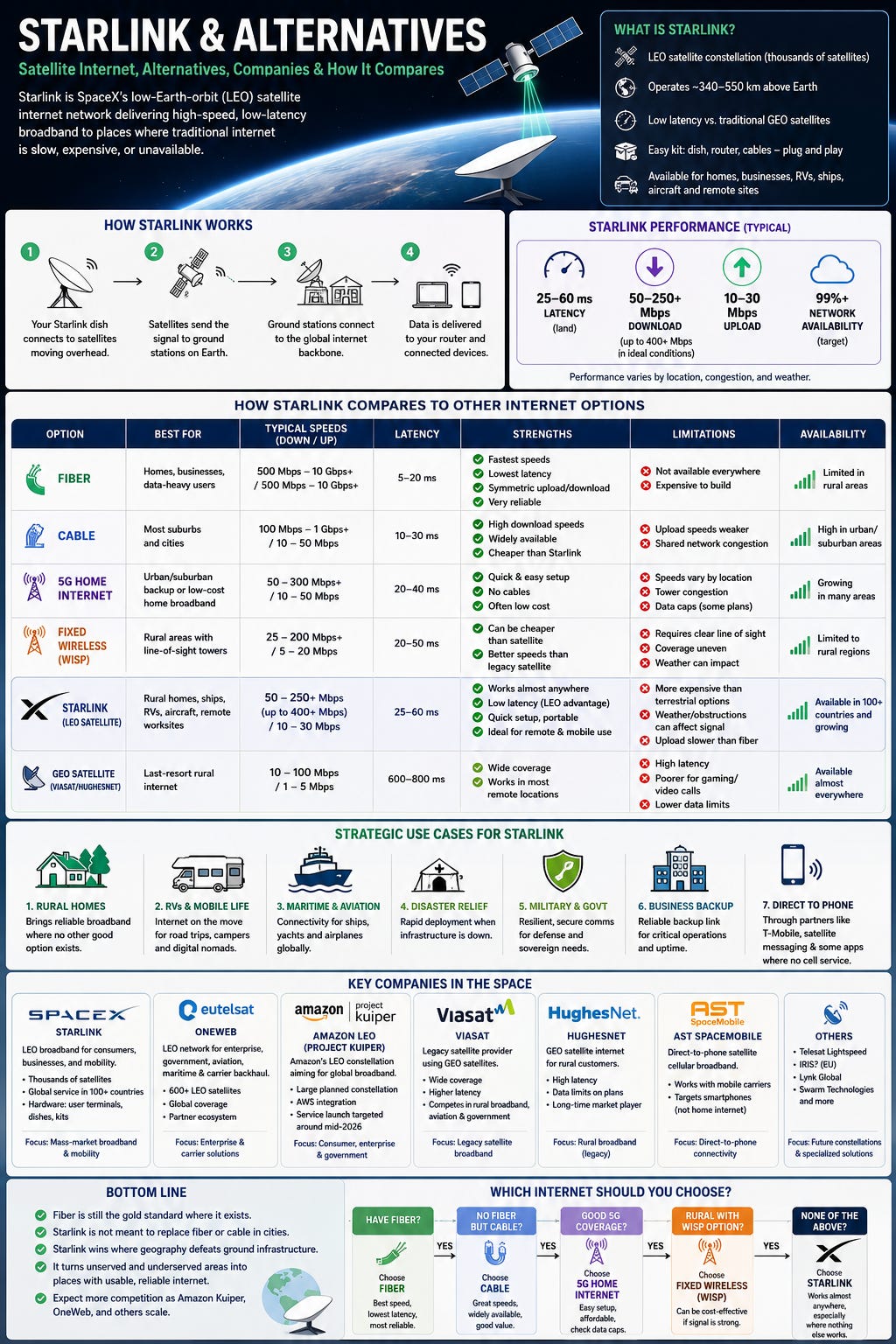
Although Starlink currently leads the market, competition is intensifying.
Several major players are investing billions of dollars into next-generation satellite networks.
Amazon Project Kuiper
Amazon’s Project Kuiper is perhaps the most significant challenger.
Leveraging Amazon’s cloud infrastructure, logistics capabilities, and financial resources, Project Kuiper aims to build a large-scale broadband constellation capable of competing directly with Starlink.
Amazon’s integration with AWS could create compelling enterprise opportunities and cloud-native networking solutions.
The company possesses the resources necessary to remain a long-term competitor.
Eutelsat OneWeb
OneWeb focuses heavily on enterprise, government, aviation, and maritime customers.
Rather than targeting mass consumer adoption to the same degree as Starlink, OneWeb emphasizes specialized connectivity markets that require reliable global coverage.
Its partnerships and enterprise orientation create a distinct strategic position within the industry.
AST SpaceMobile
AST SpaceMobile is pursuing a different vision.
Rather than requiring specialized user terminals, AST seeks to connect directly with existing smartphones.
If successful, this approach could dramatically expand connectivity by enabling ordinary mobile devices to communicate with satellites without additional hardware.
Direct-to-phone connectivity represents one of the most closely watched developments in the industry.
Telesat and Other National Initiatives
Several countries view satellite internet as a strategic asset rather than merely a commercial opportunity.
Canada’s Telesat, China’s Guowang initiative, and various sovereign-backed programs aim to ensure national control over critical communications infrastructure.
These projects reflect growing recognition that connectivity has become a geopolitical capability as well as an economic one.
The Market Opportunity
The satellite internet market is expanding rapidly.
Several factors are driving growth simultaneously.
First, billions of people remain underserved or entirely unconnected.
Second, mobility markets continue expanding. Airlines, shipping fleets, remote industrial operations, military organizations, and global enterprises increasingly require connectivity wherever they operate.
Third, governments view resilient communications infrastructure as essential for national security and disaster preparedness.
Finally, direct-to-device technologies could dramatically increase the addressable market by bringing satellite connectivity directly to smartphones.
Taken together, these trends create one of the largest infrastructure opportunities of the coming decade.
Satellite internet is not simply competing for existing broadband customers.
It is creating entirely new connectivity markets.
Strategic Applications Beyond Consumer Broadband
Many people view satellite internet primarily as a consumer product.
In reality, some of the most valuable opportunities lie elsewhere.
Aviation increasingly relies on broadband connectivity for passengers, crew operations, and aircraft systems.
Maritime operators require reliable communications across global shipping routes.
Military organizations need resilient networks capable of operating independently of terrestrial infrastructure.
Emergency response teams depend on communications when disasters disable conventional networks.
Governments seek sovereign communications capabilities that remain operational during crises.
These applications often command significantly higher margins than residential broadband services.
Consequently, enterprise, mobility, and government segments may become increasingly important drivers of industry profitability.
Risks and Challenges
Despite its promise, satellite internet faces meaningful challenges.
Building global constellations requires enormous capital investment.
Thousands of satellites must be manufactured, launched, maintained, and eventually replaced.
Regulatory considerations remain complex, particularly regarding spectrum allocation and international operations.
Competition is intensifying as new entrants deploy competing networks.
Technological innovation continues at a rapid pace, creating uncertainty regarding long-term market structure.
Additionally, the industry remains exposed to launch failures, geopolitical tensions, and changing regulatory frameworks.
While the opportunity is substantial, execution remains critical.
The Future of Connectivity
The most important takeaway from the satellite internet revolution is that connectivity is becoming infrastructure-independent.
Historically, internet access depended on physical proximity to networks.
The future increasingly depends on access to intelligent global systems operating from space.
This transition could reshape how people live, work, travel, learn, and conduct business.
Remote communities may gain access to opportunities previously unavailable.
Global enterprises may operate with greater flexibility.
Governments may improve resilience and national security.
Billions of people may join the digital economy.
The implications extend far beyond telecommunications.
They touch nearly every aspect of modern society.
Conclusion
Satellite internet represents one of the most important infrastructure developments of the twenty-first century.
By overcoming the geographic limitations of terrestrial networks, modern LEO constellations are creating a new layer of global connectivity capable of reaching virtually any location on Earth.
Starlink currently leads this transformation through an unprecedented combination of satellite technology, launch capability, operational scale, and vertical integration. However, competitors such as Amazon Project Kuiper, OneWeb, AST SpaceMobile, and emerging international initiatives are accelerating investment and innovation across the sector.
The long-term significance of this industry extends beyond internet access.
Satellite networks are becoming foundational infrastructure for commerce, mobility, defense, communications, and economic development.
Just as railroads connected nations, power grids electrified economies, and cellular networks transformed communication, satellite internet may become one of the defining infrastructure platforms of the next generation.
The race is not merely about broadband.
It is about who builds and controls the next global layer of the internet itself.