

Most people still think of AI as a tool.
A chatbot.
A writing assistant.
A faster search engine.
They’re thinking too small.
The most successful operators are no longer using AI as a tool.
They’re using AI as an organization.
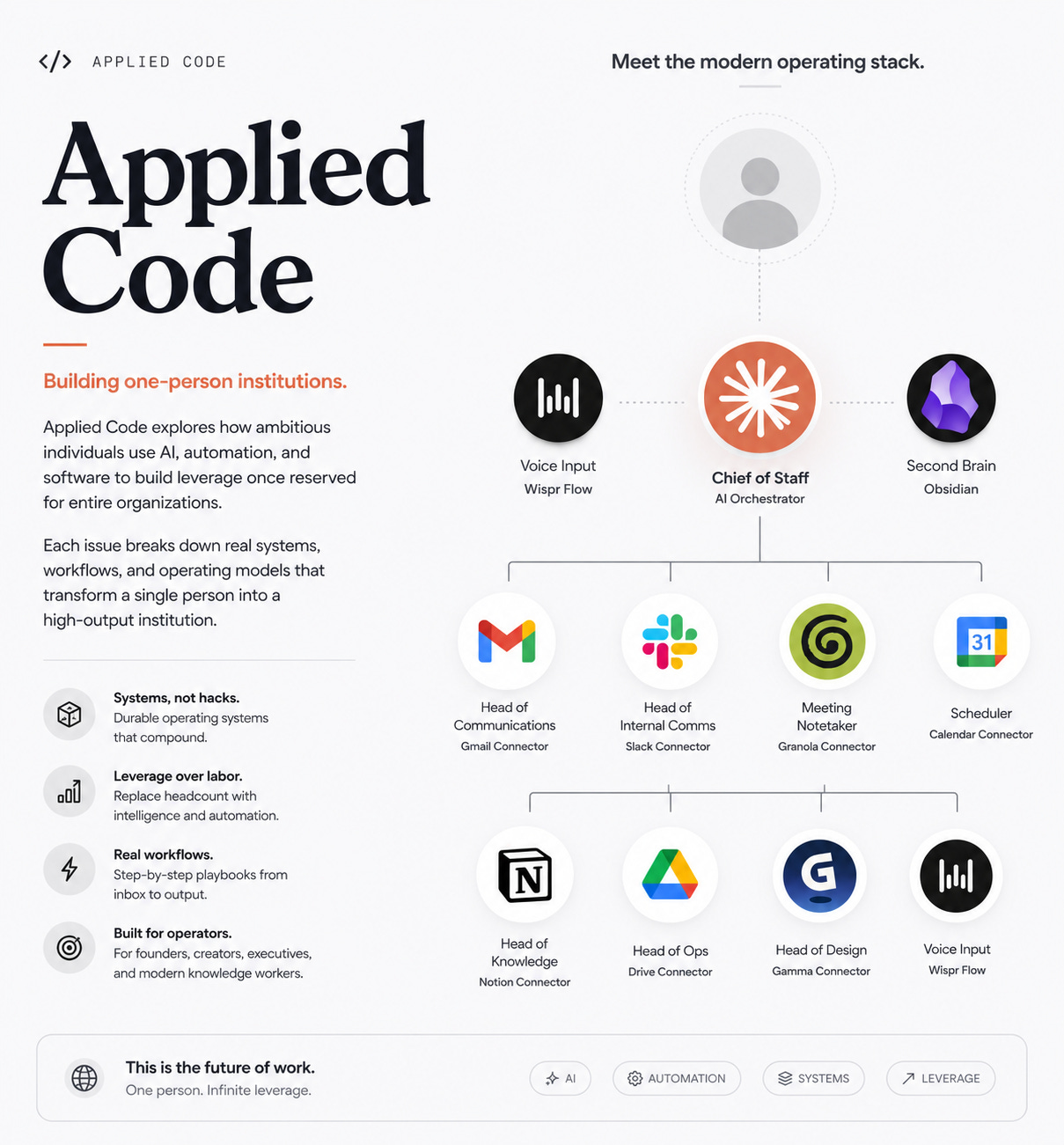
The modern entrepreneur doesn’t need a traditional team to build at scale. Instead, they build what Applied Code calls an Operating Stack—a collection of specialized systems, agents, automations, and software that function as an executive team.
The goal is simple:
Replace organizational complexity with intelligent systems.
Not to eliminate people.
But to maximize leverage.
The Death of Traditional Headcount
For decades, growth followed a predictable formula.
More customers required:
More employees
More managers
More meetings
More overhead
The result was complexity.
Today, intelligence has become software.
The question is no longer:
“How many people do I need?”
The question is:
“How many systems can I orchestrate?”
This shift changes everything.
A founder with the right operating stack can now perform work that previously required entire departments.
The Applied Code Operating Stack
Every high-performance operator needs a central command layer.
Think of yourself as the CEO.
Everything else exists to extend your capabilities.
Layer 1: The Operator
At the top sits a single human.
You.
Your role is not execution.
Your role is:
Vision
Judgment
Strategy
Decision Making
Machines execute.
Humans direct.
The more intelligence you can coordinate, the more leverage you create.
Layer 2: The Chief of Staff
Every Fortune 500 CEO has someone responsible for orchestration.
In a modern operating stack, this role belongs to your AI Chief of Staff.
This is the most important AI role inside your system.
Its responsibilities include:
Coordinating agents
Prioritizing projects
Tracking initiatives
Routing tasks
Managing information flow
Producing executive briefings
Think of this agent as your command center.
Without it, systems become fragmented.
With it, systems become an organization.